
Inturduction
In 2026, as cross-border independent stores and social e-commerce orders continue to expand in scale, the overall return volume of overseas parcels keeps rising year by year. Unlike domestic e-commerce with mature reverse logistics channels, cross-border returned goods involve international round-trip freight, customs clearance restrictions and scattered inspection links. A large number of returned products are directly discarded or sent back to China at high cost, bringing huge waste of product value and capital occupation. According to global cross-border supply chain research data, the average return loss accounts for 12% to 25% of merchants’ annual gross profit, while less than 30% of sellers have built standardized local returned goods processing systems. This industry insight interprets the new development direction of cross-border reverse logistics in the current market, summarizes typical operational pain points in the return link, and provides replicable disposal plans and management strategies to help brands turn after-sales losses into recyclable inventory assets.
Why Reverse Logistics Becomes a Core Must-Solve Industry Topic in 2026
Cross-border e-commerce has stepped out of the simple stage of only focusing on outbound delivery, and the whole-link supply chain competition has extended to after-sales return management. In previous years, most sellers ignored reverse logistics layout for the sake of simplifying operation procedures, and adopted rough processing methods for all returned parcels.
First of all, round-trip international transportation cost is extremely high. Sending returned goods back to China for inspection often costs more than the product itself, resulting in direct net loss for each returned order. Secondly, many countries and regions have strengthened environmental supervision on imported discarded goods. Arbitrary abandonment of returned items may trigger policy penalties and brand credit risks.
In addition, consumers’ requirements for after-sales service are gradually standardized. Platforms and independent station buyers are more willing to choose merchants with clear return rules and fast after-sales response. Imperfect return mechanisms will directly reduce store trust score and natural search weight.
A senior cross-border industry research analyst commented: “Forward fulfillment determines order volume, while reverse logistics decides real net profit. In 2026, standardized overseas local return processing is no longer an optional service, but a basic threshold for long-term stable operation of cross-border brands.”
Four Major Pain Points Restricting Cross-border Return Profit Control
Pain Point 1: Blindly sending all returned goods back to mainland China Merchants lack overseas inspection and reprocessing capabilities, so all abnormal parcels are transported back domestically. Double freight and long customs cycle make the product basically lose secondary sales value.
Pain Point 2: No classification mechanism for returned parcels All returned items are treated uniformly without distinguishing intact unused goods, slightly damaged packaging products, defective goods and wrong shipped items. A large number of resalable inventory is directly scrapped, causing unnecessary asset loss.
Pain Point 3: Incomplete real-time information tracking of return orders Sellers cannot obtain logistics status and reason for return in a timely manner, unable to lock problem SKUs and optimize listing descriptions, leading to repeated return risks of the same products.
Pain Point 4: Unclear billing standards for third-party after-sales services Many logistics providers hide inspection fees, warehousing fees and scrapping handling charges. Merchants cannot accurately calculate the actual after-sales cost, and profit accounting always has large deviations.
Standard Return Link Optimization & Reverse Logistics Launch Process
Step 1: Set clear return address and rule display on listings Mark unified local overseas warehouse return address on product pages and order confirmation emails, specify valid return period and eligible return scenarios, reduce invalid malicious return applications from the source.
Step 2: Uniformly gather returned parcels to designated overseas warehouse Cooperate with a fulfillment provider with local after-sales capabilities to collect all returned packages into fixed overseas storage nodes, avoiding scattered parcel storage and information loss.
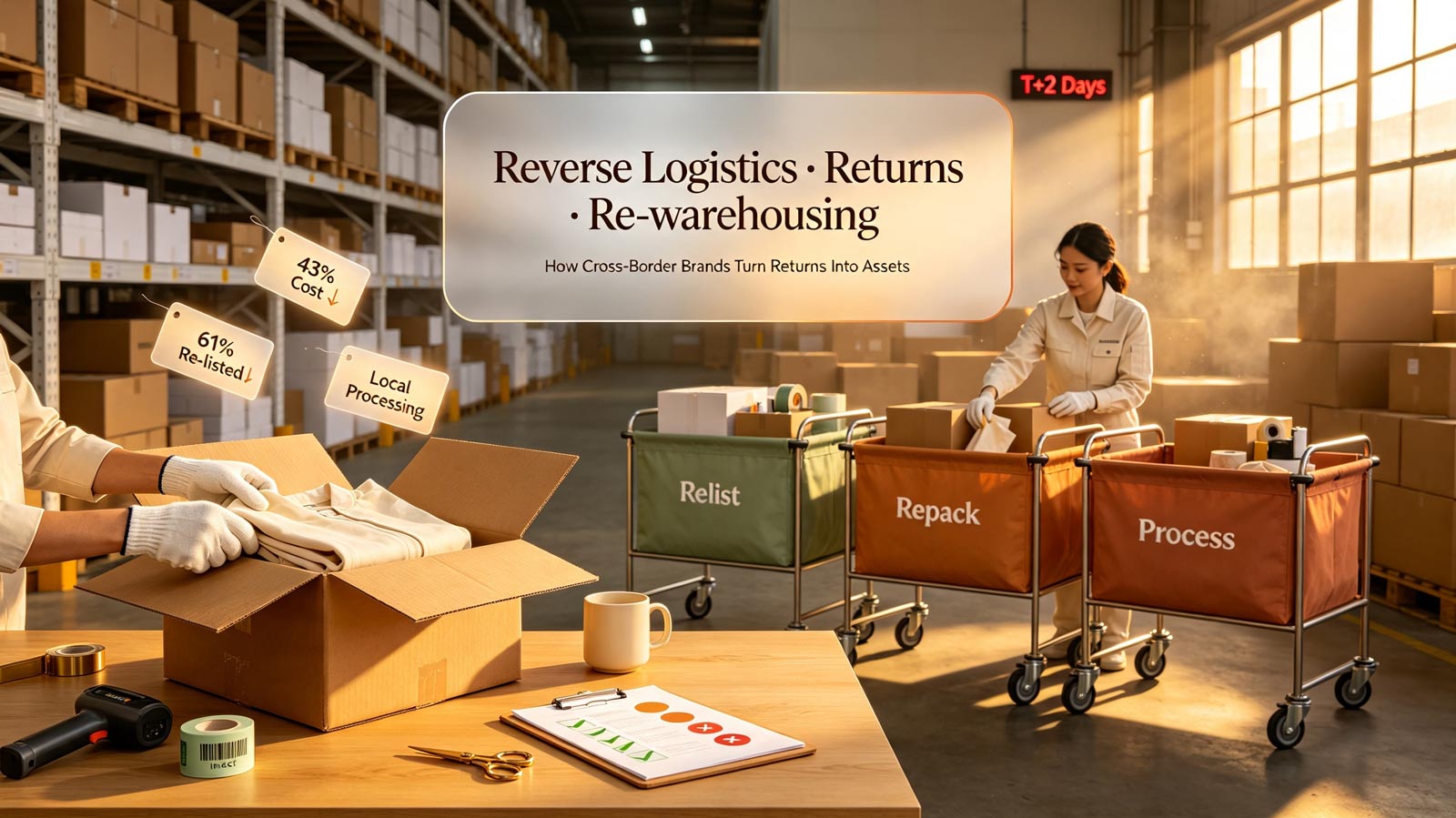
Step 3: Carry out multi-dimensional classification inspection of returned goods Professional operators classify parcels into four categories: intact and relistable products, repackable items, defective products to be scrapped, and goods to be returned to China according to appearance, function and packaging condition.
Step 4: Implement targeted disposal for different types of returned inventory Put qualified intact goods back into normal inventory for secondary sale; repack slightly damaged outer packages at low cost; apply for centralized scrapping for seriously damaged products; only arrange back-to-China transportation for special customized goods.
Step 5: Summarize return data and iterate front-end operation strategies Export monthly return reason statistical reports, optimize picture display, size parameter description and product quality control for high-return SKUs, fundamentally cut subsequent return generation rate.
Reverse Logistics & Return Disposal Operation Checklist
- Add standardized return policy module on independent station checkout and product detail page to reduce unnecessary customer returns caused by information asymmetry.
- Confirm the item-by-item charging standard of overseas inspection, storage and repacking with the fulfillment partner in writing to avoid hidden extra expenses.
- Establish SKU return rate statistical table every week, lock top high-return products and adjust listing or stop stocking in time.
- Prioritize local re-warehousing and repacking instead of cross-border return to China to minimize comprehensive logistics expenditure of after-sales links.
- Open real-time return logistics tracking permission in the merchant background to grasp each parcel’s disposal progress at any time.
- Sign a fixed-cycle scrapping and environmental disposal agreement for unsalable defective returned goods to avoid local policy compliance risks.
Real Merchant Reverse Logistics Cost Optimization Success Case
A European apparel independent station brand has been plagued by high return rates for a long time. Clothing products have frequent size mismatch and color difference returns. In the early stage, the merchant chose to ship all returned orders back to China, resulting in nearly 30% of orders falling into loss state, and the capital turnover pressure was extremely prominent.
After accessing Globe Fulfillment’s one-stop reverse logistics system and overseas warehouse classified inspection service, the brand unified all returned parcels to the designated European self-operated warehouse for unified sorting and disposal. Qualified products are directly relisted for sale locally, and only unrepairable defective products are processed in a centralized manner.
Within two months of strategy adjustment, the merchant’s comprehensive return loss decreased by 43%, the proportion of returned goods re-entering inventory reached 61%, and the overall store net profit margin increased significantly.
The store operation manager gave feedback: “We used to regard returns as a completely lost cost. After local classified disposal, most products can be sold again. The reverse logistics system fills the biggest profit leak in our supply chain.”
Key Takeaways
- In the 2026 cross-border e-commerce competition, reverse logistics and returned goods management have become important factors determining the final profit level of merchants.
- The biggest loss of cross-border returns comes from blind back-to-China transportation and indiscriminate scrapping without classification inspection.
- Local overseas warehouse centralized receiving, inspection and classified disposal is the most cost-effective standard model for reverse supply chain management.
- Linking return data with front-end listing and stocking decisions can form a closed loop optimization and continuously reduce the overall store return rate.