
Introduction
In 2026, emerging cross-border markets such as Southeast Asia, Latin America and the Middle East continue to maintain rapid growth. Unlike mature credit-card-based markets, these regions rely heavily on COD (Cash on Delivery) transactions, which account for more than 65% of overall local e-commerce orders. However, most sellers face universal pain points: high COD rejection rate, uncontrollable last-mile delivery, opaque settlement cycles, and rising invalid logistics costs. Industry data shows that nearly 40% of COD sellers fail to achieve stable profits due to immature fulfillment and risk control systems. This industry insight systematically sorts out the latest 2026 COD fulfillment trends, analyzes core operational risks, and provides standardized risk avoidance and profit optimization solutions to help sellers achieve sustainable growth in high-potential emerging markets.
Major Changes in Global COD Cross-border E-commerce in 2026
The global COD track is undergoing obvious structural upgrades this year. In the past, most merchants adopted passive parcel delivery mode, resulting in extremely high rejection rates and uncontrollable after-sales losses. In 2026, mainstream brands are shifting from “blind shipment” to “data-driven pre-risk assessment + localized warehousing fulfillment” mode.
First, market demand is becoming more standardized. Local consumers are increasingly sensitive to delivery speed, product quality and after-sales service. Simple low-price strategies can no longer support long-term order conversion. Localized fast delivery within 3–6 working days has become the basic threshold for user trust.
Third, industry profit distribution is further concentrated. Sellers with stable localized warehouse networks, low rejection rates and standardized risk control systems are continuously increasing market share, while small and medium sellers with extensive delivery modes are gradually eliminated by the market.
A senior cross-border industry researcher commented: “The COD track is no longer a traffic-dividend industry. It has completely entered the refined fulfillment competition stage. The core of future profitability lies in stable delivery capability and precise risk control.”
Core COD Fulfillment Pain Points Restricting Seller Profits
Most COD profit losses do not come from product gross profit, but from invisible supply chain and operational loopholes.
The first pain point is blind direct shipment leading to ultra-high rejection rate. Many sellers ship directly from China without user screening, resulting in false orders, address errors and malicious rejection. Once the order is rejected, merchants need to bear both round-trip logistics costs and product losses, forming a full-order loss.
The second pain point is unstable last-mile delivery quality. Local courier teams in emerging markets have uneven service standards. Unstandardized phone confirmation, delayed delivery and arbitrary return problems seriously affect order completion rates and fund recovery efficiency.
The third pain point is opaque settlement rules and long capital cycles. Many third-party logistics providers have hidden fees, delayed settlement and unclear deduction standards, making it impossible for sellers to accurately calculate real profit margins.
The fourth pain point is disordered return processing. Without localized return warehouses and inspection mechanisms, most returned goods cannot be resold, resulting in continuous inventory waste and capital pressure.
2026 Standard COD Full-link Optimization Process
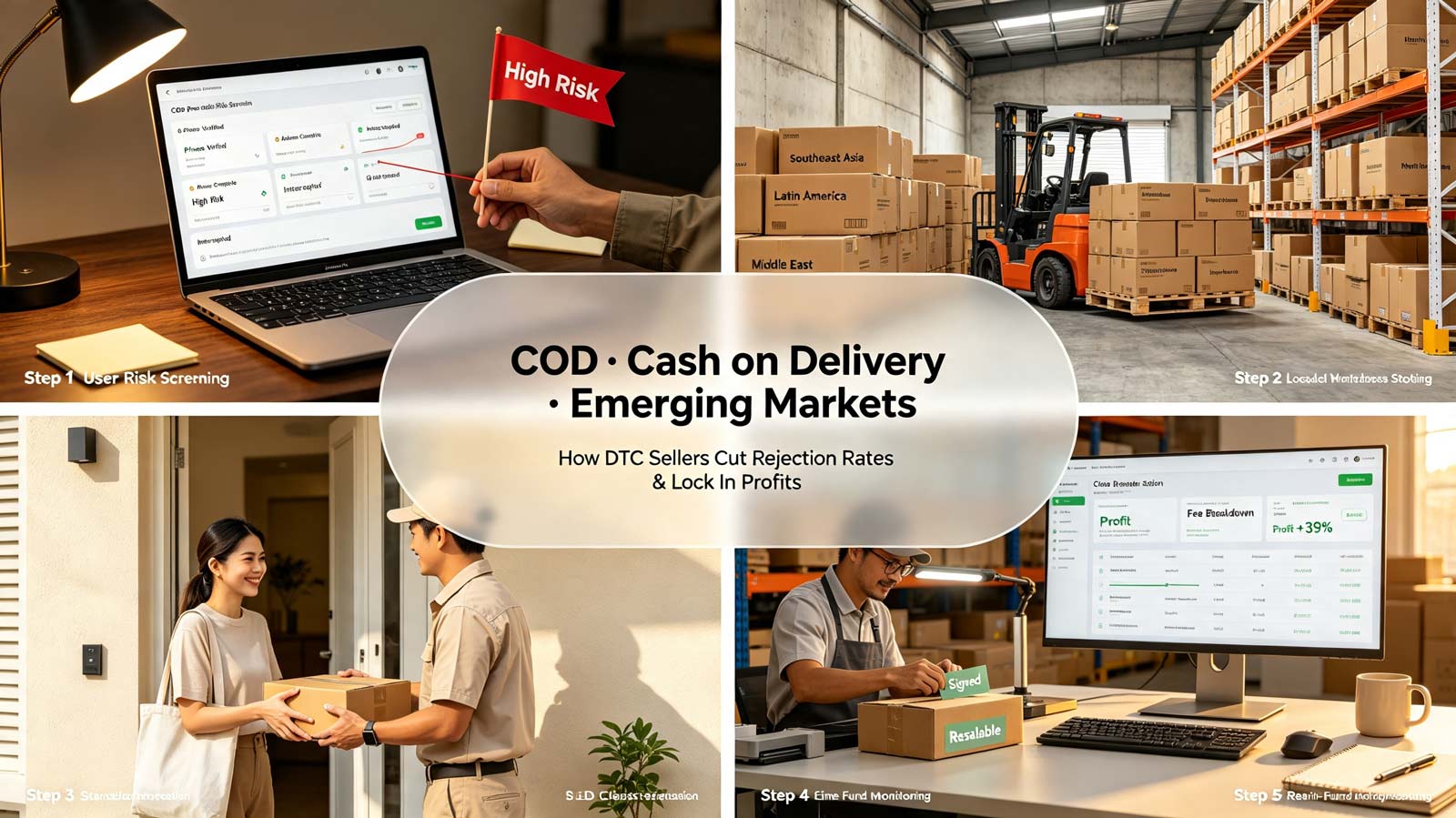
Step 1: Pre-order user risk screening
Verify user phone validity, address completeness and historical order records before delivery. Intercept high-risk false orders in advance to avoid invalid logistics loss.
Step 2: Localized overseas warehouse stocking mode switching
Transfer hot-selling SKUs to target market overseas warehouses in advance, realize local outbound delivery, greatly shorten delivery cycle, and improve user sign-up willingness.
Step 3: Standardized delivery appointment & secondary redelivery mechanism
Standardize pre-delivery phone confirmation and door-to-door appointment processes. For missed delivery orders, trigger systematic secondary redelivery to reduce unnecessary rejection rates.
Step 4: Real-time order & fund data monitoring
Track order outbound, transportation, signing and settlement status in real time, clarify each fee and deduction detail, and realize transparent profit accounting.
Step 5: Classified processing of returned inventory
Complete return inspection, repackaging and re-warehousing locally for intact goods, and realize secondary sales to maximize asset utilization.
COD Operation Risk Control & Profit Improvement Checklist
1. Establish high-risk user database, intercept repeated false order users, and continuously optimize order quality.
2. Gradually replace cross-border direct shipping with local warehouse delivery to reduce rejection rate caused by long transportation cycles.
3. Sort out SKU rejection data regularly, eliminate high-loss and high-rejection products, and focus on operating stable profit SKUs.
4. Cooperate with standardized local fulfillment teams to ensure unified last-mile delivery service standards.
5. Check settlement statements monthly, sort out abnormal deduction items, and avoid hidden cost erosion.
6. Make full use of return reprocessing mechanism to reduce inventory waste and improve overall order profitability.
Real Seller COD Fulfillment Optimization Case
A cross-border beauty and daily necessities seller has long been engaged in Southeast Asian COD business. Relying on traditional direct shipment mode, the store maintained a high order volume but suffered continuous losses, with the overall rejection rate as high as 38%. A large number of orders resulted in double losses of goods and freight, and the capital turnover pressure was huge.
After cooperating with Globe Fulfillment, the merchant switched to localized overseas warehouse stocking + standardized COD full-link fulfillment solution. The team completed user risk screening before shipment, optimized last-mile delivery procedures, and realized classified return processing.
After one month of optimization, the merchant’s COD rejection rate dropped from 38% to 16.5%, invalid logistics costs decreased by 47%, and the overall monthly profit increased by 39%.
The brand founder shared: “COD business looks simple, but the hidden losses are huge. Only standardized localized fulfillment and precise risk control can turn high order volume into real profits.”
Key Takeaways
1. In 2026, the COD track has shifted from traffic-driven growth to fulfillment-driven profitable growth.
2. High rejection rate, disordered delivery and unmanaged returns are the three core sources of COD merchant losses.
3. Localized overseas warehouse fulfillment + full-link risk control is the standard model for long-term stable operation of emerging market COD business.
4. Data screening, standardized delivery and return reprocessing can effectively help sellers reduce losses and increase net profit margins.