
Introduction
The Psychology of the Surprise Fee — and the Data Behind It
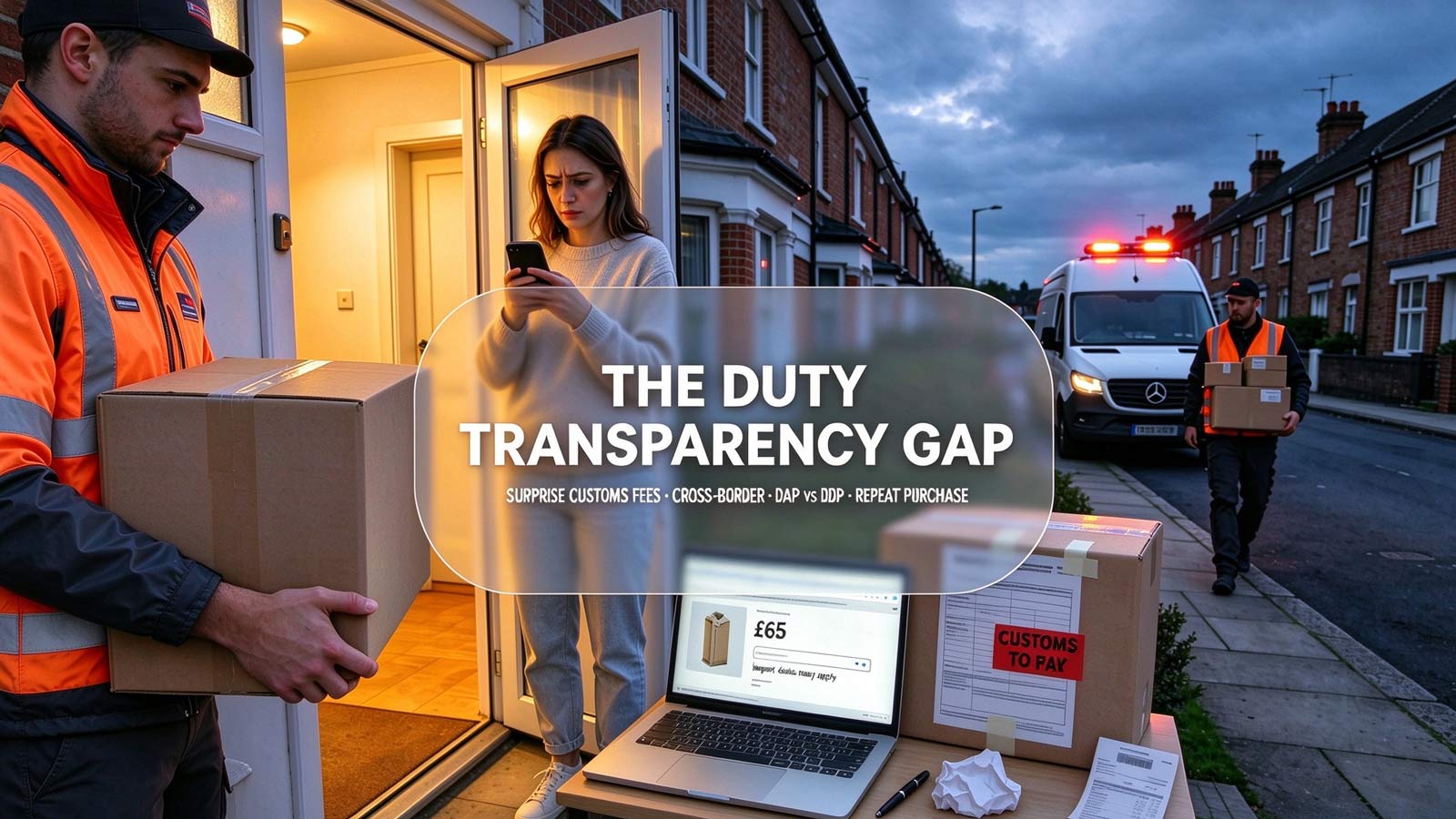
A shipping fee shown at checkout is a known cost — the customer has mentally "paid" it before the order completes. A customs fee collected at the door is fundamentally different. It reopens a transaction the customer believed was closed, at the moment of maximum inconvenience: the courier is standing there, often demanding cash or an online payment before releasing the box.
The scale of the problem is documented, not anecdotal. In Avalara's 2024 cross-border survey of businesses and consumers:
- 58% of consumers who buy cross-border reported surprise customs charges upon delivery, and 30% described those costs as "shocking."
- 49% refused delivery altogether when hit with unexpected charges.
- 75% said they would reconsider shopping with that retailer after such an experience.
- Meanwhile, 75% of businesses surveyed still ship DAP (buyer pays duties at delivery) — 30% exclusively so — despite customers naming surprise fees a top pain point.
There is a striking mismatch in these numbers: the practice most sellers default to is precisely the one most likely to end the customer relationship. For a deeper look at the psychology, Baymard Institute's long-running checkout research consistently ranks "extra costs too high / unexpected fees" among the top stated reasons for cart abandonment — and a doorstep fee is an after-checkout version of the same trigger.
Where the Gap Hides in Your Funnel
he gap is rarely one big lie — it's a chain of small omissions:
- The product page. The price anchors the customer. Anything added later feels like deception, even when it was legally unavoidable.
- The shipping method selection. DAP-by-default quietly makes the customer the importer of record. The cheaper-looking shipping option is often the one that shifts the entire tax burden to a buyer who never agreed to it. Under DAP the carrier typically adds a brokerage or "advancement" fee on top of the duty itself, so the surprise bill is usually larger than the duty alone.
- The fine print. Disclaimers buried in Terms & Conditions are functionally equivalent to no disclosure at all — customers don't read them, and regulators increasingly treat unclear total-price display as a consumer-protection issue rather than a contract question.
A Composite Case: Switching a UK Lane from DAP to DDP
The following is a composite scenario built from order patterns we see repeatedly across UK-bound apparel sellers (figures illustrative, not a single client):
A mid-sized DTC brand ships a £65 average order to UK customers via DAP. One terminology note: goods under the UK's £135 threshold owe no customs duty — the courier collects import VAT plus a clearance fee, which customers experience as one undifferentiated "surprise bill." In a typical month of 1,000 UK orders, roughly 90 parcels are refused or abandoned at the doorstep after the import charges notice — a ~9% refusal rate, in line with FlavorCloud's 2025 estimate that ~10% of parcels shipped with unpaid duties end up refused.
The brand switches the lane to DDP through its fulfillment partner, absorbing an average of £4–6 per order in prepaid VAT and clearance costs — and prices it into the product.
What changes:
- Doorstep refusals drop to near zero — the parcel simply arrives, no bill attached.
- UK support tickets about customs disappear from the queue.
- The brand adds "Duties & taxes included — no surprise fees at delivery" to the product page, which becomes a genuine conversion differentiator in a category where competitors still show a lower sticker price plus fine print.
The critical caveat: DDP is only as clean as your compliance underneath. Quaderno's guidance on the four questions to answer before quoting DDP is worth taking seriously — can you legally act as importer of record in that country, can you recover the import VAT, do you know the landed cost at point of sale, and can the declaration be filed correctly? Quoting DDP without those answers in place is how shipments end up held in customs anyway, with the customer caught in the middle.
The Landed-Cost Disclosure Playbook
Step 1 — Quote the landed cost at checkout. Show a single all-in price with duties estimated by destination before payment. Avalara's survey found 63% of supply chain professionals already display total landed cost at checkout — a majority practice, and among those who do, 94% cite transparent customer experience as the reason, with 61% citing reduced cart abandonment. Transparency is becoming table stakes, not a differentiator.
Step 2 — Match Incoterms to price band and market — and to your own compliance capacity. A pragmatic starting framework: DDP (or IOSS for EU consignments ≤€150) as default for DTC orders; DAP reserved for B2B buyers who import regularly and expect it; explicit disclosure whenever a customer will owe anything at delivery. Your actual break-even refusal rate depends on your margins — pull your last 100 cross-border orders, count duty-collect refusals, and compare against your own per-order economics rather than any universal threshold.
Step 3 — Own the doorstep moment. If charges remain payable on delivery, send a pre-arrival notification stating the amount, why it exists, and a link to pay online. If you shipped DDP, say so proactively: "No extra fees on delivery — duties included." In most niches, that sentence is still rare enough to be worth advertising.
One forward-looking note for EU lanes: the current €3 flat transitional duty is temporary and expires in July 2028, after which normal HS-code-based duties resume. If your EU pricing and Incoterms decisions assume today's €3 stays permanent, build in a review point before that date — or you'll be re-opening this exact gap from scratch.
Core Takeaways
- The refusal risk is quantified, not hypothetical. Avalara's 2024 survey found 49% of consumers refuse delivery over surprise customs fees, and 75% reconsider the retailer — the default DAP practice directly manufactures churn.
- The policy backdrop has structurally changed. US de minimis ended August 2025 for all countries; the EU abolished its €150 duty exemption on July 1, 2026 (with a €3/item transitional duty charged to businesses, expiring July 2028, and a UK £135 threshold still in place separately). Almost every parcel into major Western markets is now a dutiable event.
- DDP wins on modeled economics — when compliance supports it. Compare your own refusal and chargeback costs against prepaid duty costs per lane, but only ship DDP where you can genuinely act as importer of record and recover VAT.
- Transparency converts better than cheapness. A single all-in landed price, disclosed early, is both a conversion asset and increasingly a regulatory expectation — closing the gap is retention strategy, not just a shipping decision.