
Introduction
What the GPSR Actually Requires Beyond CE Marking
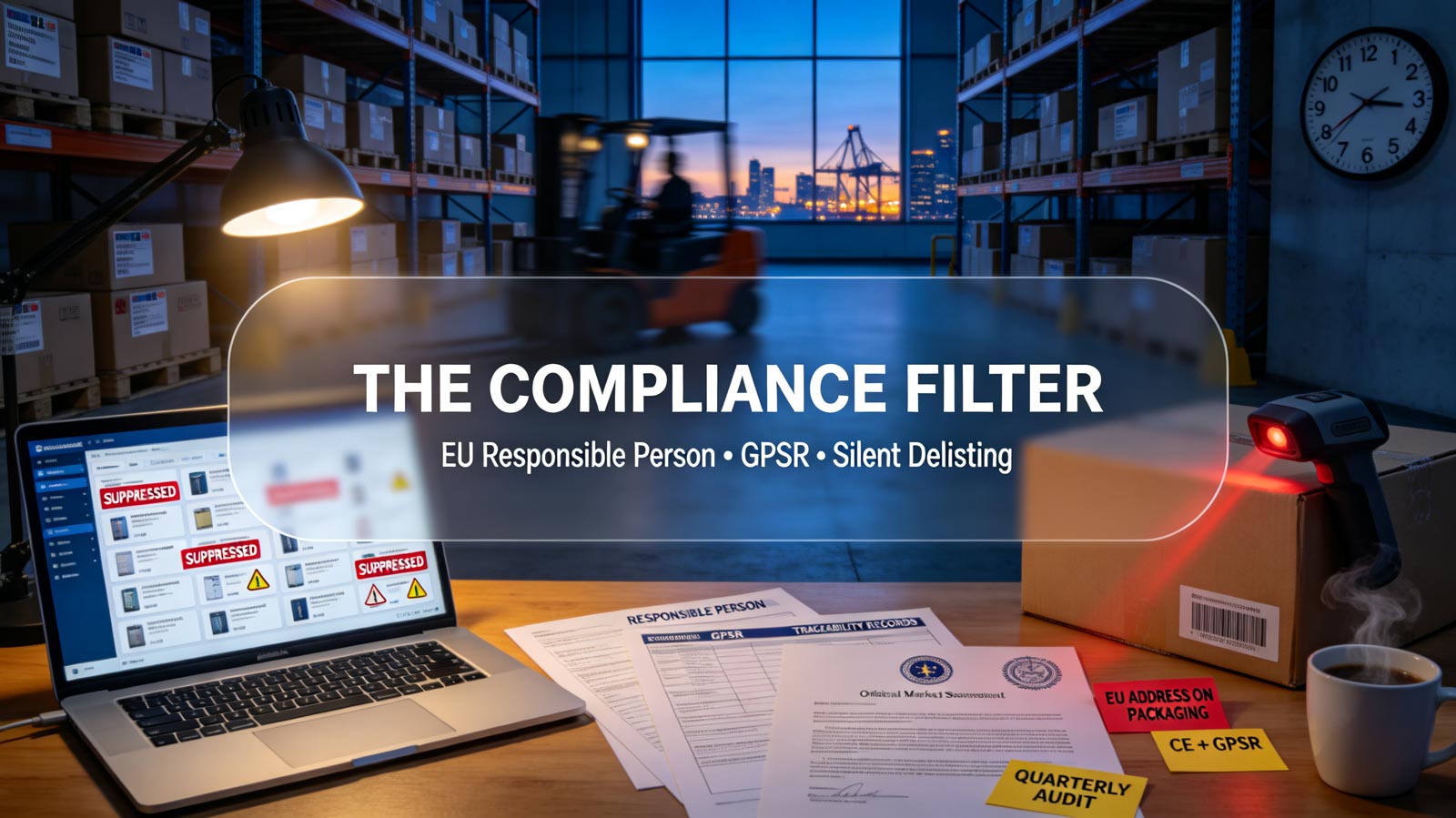
Many sellers assume existing CE certification covers EU compliance. It doesn't. The regulation adds three non-negotiable obligations on top of traditional certification:
- An EU-based Responsible Person who holds product documentation, cooperates with market surveillance authorities, and is reachable at a physical EU address — which must appear on the product, its packaging, or an accompanying document.
- Complete traceability records — manufacturer identity, batch identification, and reachable safety documentation per SKU. Files sitting in a Shenzhen office do not satisfy a German market surveillance audit.
- Listing-level verification on marketplaces — Responsible Person details must be uploaded per product category via platform compliance dashboards. The platform layer has become the enforcement layer, and it operates mechanically.
Why Cross-Border Sellers Are Being Filtered Out Quietly
Unlike tariff shocks, this filter operates invisibly. There is no dramatic fee announcement, no surcharge line item. Marketplaces use automated scans: no Responsible Person data on file means listing suppression, often without a notification carrying a clear deadline.
Common failure patterns Globe Fulfillment observes among affected merchants:
- Single-responsible-person coverage gaps. Sellers appoint one agent for their hero SKUs but leave long-tail listings unregistered. The result is partial delisting — sometimes 20–30% of a catalog — which fragments organic ranking history that took years to build.
- Documentation mismatch. Packaging address, listing data, and actual Responsible Person records conflict with each other. This doesn't just fail platform scans; it becomes a red flag for EU market surveillance inspections, where penalties escalate from correction orders to fines.
- 3PL blind spots. Inventory stored in EU warehouses without verified compliance documents creates customs detention risk even for fully labeled products. A held container costs more in demurrage and delay than most annual compliance fees combined.
- Inherited risk from suppliers. Many sellers source from manufacturers who already ship to EU distributors. They assume the upstream Responsible Person covers them — but the obligation attaches to whoever places the product on the EU market. If that's you, the gap is yours.
The Three-Step Compliance Playbook
Step 1: Map every EU-touching SKU by revenue priority. Register the SKUs driving 80% of EU revenue first, then work down the long tail. Flag high-scrutiny categories — toys, electronics, personal care, anything contacting food or skin — for stricter verification.
Step 2: Centralize documentation with your fulfillment layer. Align Responsible Person records with warehouse-side product documentation so inbound inspections, relabeling, and repackaging never break the compliance chain. Carton-level verification by your 3PL eliminates mismatches between what platforms scan and what customs officers see.
Step 3: Audit quarterly, not annually. Marketplace scan logic changes without announcement; quarterly checks catch silent suppressions within weeks. Brands auditing annually often discover permanent ranking loss across entire categories.
Optional Step 4 (multi-market sellers): Route all GPSR-related notifications — from Amazon Germany, EU authorities, or logistics providers — through one designated owner. Unowned warnings simply expire.
Store Observation
A home-goods independent store operating in Germany saw 34% of its EU listings suppressed within two weeks when Amazon's automated GPSR scan ran in early 2026. The pattern behind the suppression was typical: the brand had registered its top 15 revenue SKUs but left 200+ long-tail listings untouched, assuming small-volume items flew under the radar. They didn't.
The brand recovered within 30 days by centralizing its Responsible Person documentation with its fulfillment partner and re-verifying listings in revenue-priority batches — with no permanent ranking loss. Sellers in the same category who waited over 60 days faced measurably longer recovery cycles, and several never fully rebuilt their pre-suppression organic positions despite doubling ad budgets. The difference was not budget. It was response latency.
Core Takeaways
- The EU Responsible Person requirement is now an enforced listing gate, not a paperwork formality — missing it means silent delisting, not warnings.
- CE marking alone no longer suffices; traceability records, EU address labeling, and per-SKU registration form the complete compliance chain.
- Centralizing documentation with your fulfillment partner protects compliance integrity through relabeling, repackaging, and multi-warehouse movement.
- Quarterly compliance audits prevent the ranking decay that makes late recovery far costlier than prevention.