

Introduction
From Policy Draft to Enforcement Wave
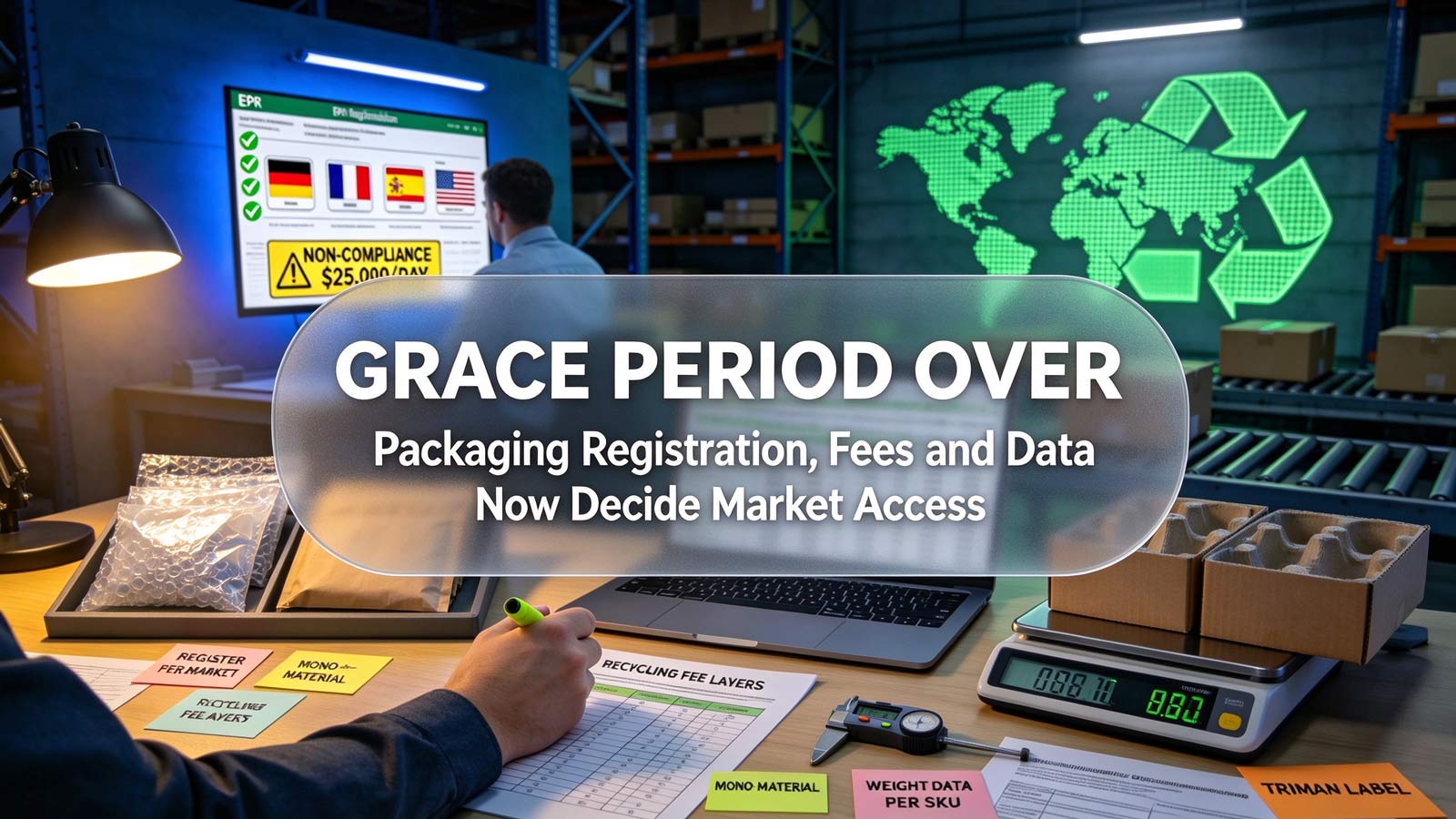
For years, EPR existed in the safe category of "future regulation." That grace period is ending. Oregon's packaging EPR program began full enforcement on July 1, 2025, with noncompliance penalties reaching up to $25,000 per day. Colorado's program starts collecting producer dues in January 2026. Washington requires producers to join a PRO during 2026, and products from non-member companies cannot be sold in the state after March 2029. California's truth-in-labeling rules tighten in October 2026, banning recyclable claims on packaging that fails statewide recyclability criteria.
The EU is moving in parallel: the Packaging and Packaging Waste Regulation tightens reporting, recycled-content targets and design requirements across member states, while national systems in Germany, France, Spain and Italy continue expanding fee categories.
The direction is unmistakable: packaging compliance is shifting from a branding choice to a market-access condition.
Who Counts as a "Producer" — The Identity Trap
The single most common EPR mistake among cross-border sellers is assuming the obligation belongs to the factory. Under most regimes, the "producer" is whoever first places packaged goods on the market in that country. For a China-made product shipped from a US or EU warehouse to a domestic buyer, that is often the seller — not the manufacturer, and not the platform.
Three implications catch stores off guard:
- Dropshipping and overseas-warehouse models are not exemptions. If your inventory sits in a fulfillment center in Oregon, Germany or France and you sell to local buyers, local EPR rules generally treat you as the obligated party.
- Platform registration does not transfer liability. Marketplaces may collect data or offer pooled programs, but in most jurisdictions the placing-on-the-market responsibility still sits with the brand or importer of record.
- Each market has its own register. There is no single global EPR filing. Selling into Germany, France and Spain means three registrations, three data formats and three fee systems.
Cost Layers Sellers Keep Missing
Merchants routinely budget for the visible line item — the recycling fee — and miss the surrounding structure. A realistic 2026 cost model includes four layers:
- Registration layer: national registration fees and PRO membership dues, recurring annually per market.
- Eco-modulated fee layer: per-unit recycling fees calculated by packaging weight and material. Under eco-modulation, hard-to-recycle composites and multi-material packaging can cost several times more per kilogram than mono-material cardboard — design choices directly change your fee bill.
- Data layer: packaging material declarations require weight and material data for every SKU, every sales channel and every destination market. For stores with hundreds of SKUs, building this ledger is a real operational project, not a formality.
- Labeling layer: French Triman sorting marks, recycled-content claims and California's tightening recyclability definitions all require packaging artwork updates with legal review.
Individually each layer looks manageable. Combined, compliance typically lands between 1.5% and 4% of revenue for mid-sized cross-border sellers in covered markets — a margin line item most P&Ls have never carried.
A Four-Step Compliance Sequence
Store operators do not need a legal department to get ahead of the wave. Run this sequence in order, because each step feeds the next: Step 1: Map SKU-to-market exposure. List every destination country and US state where you warehouse or sell, then mark which SKUs ship there. Exclude small-producer thresholds where applicable — several regimes exempt businesses below defined revenue or tonnage limits.
Step 2: Register and join the right PROs. File registrations in each obligated market and join a Producer Responsibility Organization where required. Late registration is consistently more expensive and slower than filing ahead of enforcement windows.
Step 3: Build the packaging data ledger. For every SKU, capture packaging weight and material by component — mailer, box, infill, tape, inserts. Your 3PL is usually the best source: fulfillment operations physically handle every packaging component and can supply measured data instead of estimates.
Step 4: Redesign the fee-heavy packaging. Substitute composite and multi-material packaging with mono-material alternatives, right-size mailers to cut total packaging weight, and remove decorative components that add fee liability without adding protection. Fee savings from redesign routinely exceed the design cost within two quarters.
Where Fulfillment Data Becomes Compliance Data
EPR transforms packaging from an operations detail into a regulated data asset. Accurate per-SKU packaging weight, material composition and shipment volumes — the same data that drives dimensional-weight shipping costs — now also drive compliance fees and audit readiness.
This is where fulfillment infrastructure matters more than most sellers expect. A fulfillment partner with standardized SKU master data, right-sizing packaging engines and multi-region warehouse records gives you the raw material for EPR reporting at near-zero marginal effort. Sellers assembling this data manually from spreadsheets typically spend 60–80 hours per market per year on reporting alone.
Core Takeaways
- EPR enforcement is live now, not coming: Oregon fines run up to $25,000 per day, Colorado dues begin January 2026, and Washington will block non-registered sellers from 2029.
- The obligated "producer" is usually whoever first places packaged goods on the market — overseas-warehouse sellers and dropshippers are not exempt.
- Real compliance costs span four layers — registration, eco-modulated fees, data reporting and labeling — typically 1.5%–4% of revenue in covered markets.
- Packaging redesign is the highest-ROI compliance move: mono-material, right-sized packaging simultaneously cuts recycling fees, dimensional-weight shipping costs and audit exposure.
- Build your packaging data ledger from fulfillment records, not spreadsheets — SKU-level weight and material data now serves both shipping economics and regulatory reporting.