
Introduction
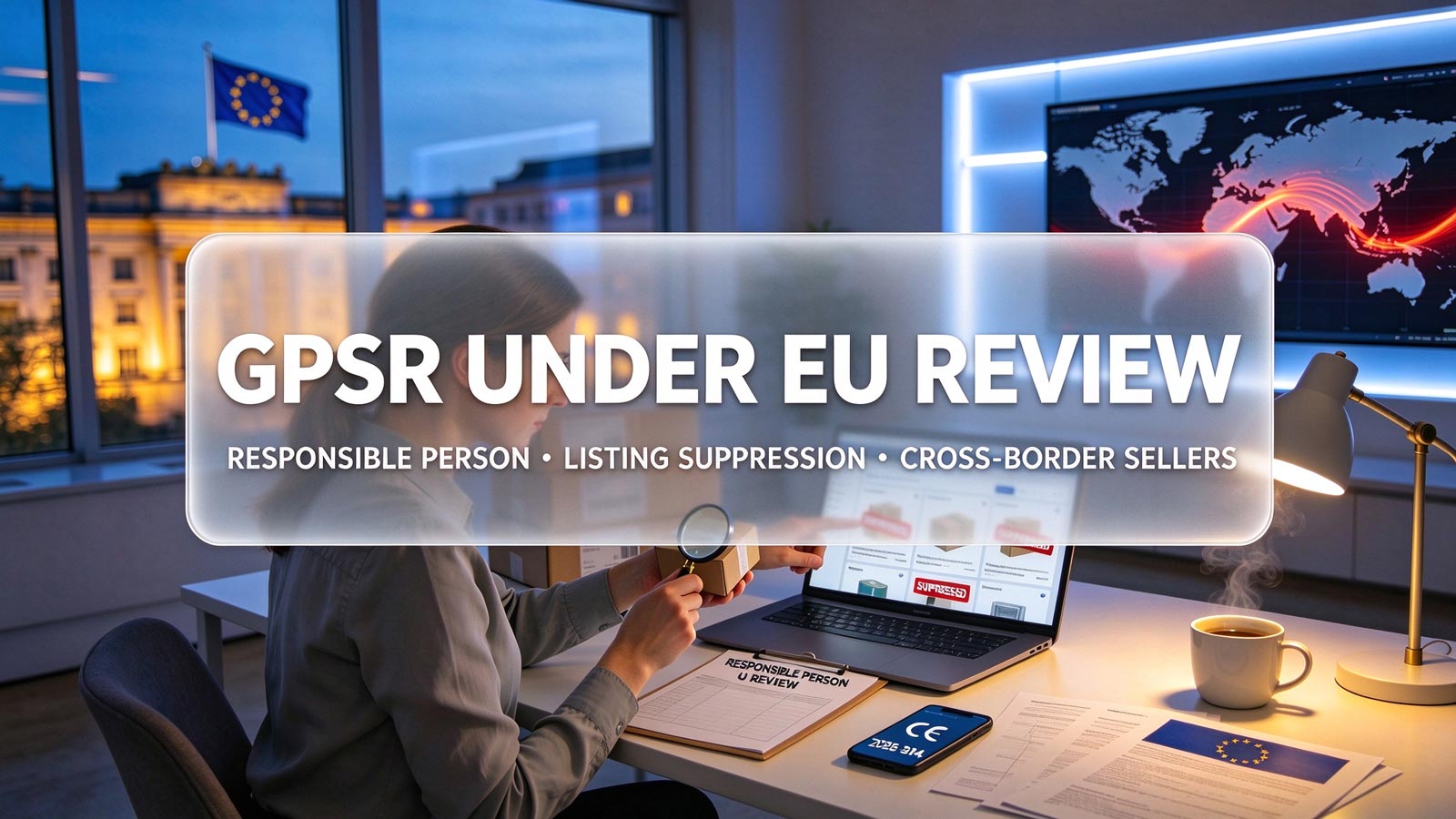
Your EU product listings can disappear from search results without a formal regulator warning. Since December 2024, the EU General Product Safety Regulation (GPSR) requires every product sold into the EU — via marketplaces or your own DTC store — to have an EU-based economic operator legally accountable for product safety.
Enforcement was light-touch in the early phase. That era is over. Throughout 2025 and into 2026, major marketplaces have started systematic delisting of products without a valid, named Responsible Person. This article breaks down the GPSR requirements, explains why this operates as a quiet filter rather than high-profile enforcement crackdowns, and outlines four common compliance gaps that get listings pulled down.
What the GPSR Actually Requires
Replacing the older Product Safety Directive, the GPSR entered full force on 13 December 2024. Its core principle is straightforward: there must be a legally identifiable party within the EU to respond if a product poses safety risks. For sellers based outside the EU, this translates to three non-negotiable obligations:
- Appoint an EU Responsible Person. For most online consumer goods — apparel, electronics, toys, beauty devices and homeware — you need an EU-established entity listed on product packaging and sales listings. This party may be the EU manufacturer, EU importer, or an officially appointed authorized representative. A fulfillment provider may only fill this role if formally mandated to take on this legal safety responsibility.
- Add traceable labeling. Each product or its packaging must display the Responsible Person's full name, postal address and contact details, plus product identifiers: type reference, batch or serial number. Safety instructions must also be available in a language understood by consumers in the target EU market.
- Maintain recall readiness. When safety issues emerge, you need to trace affected batches and notify relevant buyers. That means structured, searchable batch and sales records — not static spreadsheets that quickly go out of date.
Why This Is a Quiet Filter, Not a Loud Crackdown
Most sellers never receive an official penalty letter from EU authorities. Instead, they get automated marketplace notifications. Amazon, AliExpress, Temu and other platforms first requested Responsible Person documentation for high-risk categories, before rolling out checks across all product lines. Listings with invalid or missing details get suppressed; repeated non-compliance triggers account flags.
This is why the risk is easy to underestimate. Your ads continue running, your storefront looks normal — until you notice dozens of SKUs no longer appear in EU search. This filtering happens silently at ASIN / listing level, one product at a time. Too many sellers treat GPSR as just paperwork, only to discover it directly controls whether their listings stay visible.
Enforcement is also shifting. Marketplaces were the first checkpoint; regulators are now increasingly turning attention to independent DTC webstores. If you sell direct to consumers in the EU, customs and national consumer authorities can request your Responsible Person information. "We do not have one" is not an acceptable response.
GPSR Compliance Cost vs. the Cost of Delisting
The math is simple for cross-border merchants. An authorized representative service for a small product portfolio generally costs a few hundred euros per year. Adding compliant traceability stickers to goods costs only cents per unit.
The alternative is far more expensive. A suppressed EU listing does not just pause sales. It hands your organic ranking, reviews and search visibility to compliant competitors. Rebuilding rankings after weeks or months offline often costs more in ad spend than years of GPSR compliance fees. For sellers with meaningful EU sales volume, GPSR compliance is not an overhead — it is revenue insurance.
There is an extra upside: your Responsible Person setup works alongside CE marking requirements and EU EPR packaging registration, obligations many sellers already manage. Once you build one compliance layer, the marginal cost to add others falls.
Four Common Compliance Gaps That Trigger Listing Suppression
Marketplace compliance teams do not judge intent. They validate concrete data and documentation. Almost all suppressed listings stem from these four failure points:
- No valid Responsible Person on file. You may never have appointed one, or the appointed entity is not linked to your listings. Platforms verify EU physical addresses; virtual mailbox services with no underlying legal presence will fail validation sooner or later.
- Mismatch between packaging labels and marketplace listings. The name and address printed on packaging must exactly match the details uploaded to the marketplace backend. Many sellers update listing information but continue shipping old inventory — or the reverse — and get flagged during spot checks or customer complaints.
- Missing traceable product identifiers. A batch, serial or type reference lets authorities trace individual units back to production runs. Generic packaging with only a barcode rarely satisfies traceability requirements once a safety investigation opens.
- No functional recall process. Can you identify and contact every buyer who purchased batch 2026-B14 right now? If answering that requires stitching data across disjointed systems, you are not recall-ready — and platforms increasingly ask for proof of recall workflows.
Closing these four gaps is administrative work, but it matters. Your competitors follow the same checklist. Every month you delay compliance is another month their live listings capture demand that used to be yours.
Core Takeaways
- GPSR has been fully applicable since December 2024. From 2025 into 2026, marketplaces moved from information requests to systematic suppression of non-compliant listings.
- Compliance rests on three requirements: an EU-based Responsible Person, traceable labeling with local-language safety information, and searchable batch records to support recalls.
- The primary risk is silent, listing-level removal: lost organic rank, reviews and market share, rather than sudden large fines. This makes it easy to ignore until revenue drops noticeably.
- Most suppressions come from four repeat issues: missing Responsible Person, label-listing mismatches, missing product identifiers and untested recall workflows. Audit these areas now, before regulators shift enforcement focus from marketplaces to independent stores.