
Introduction
For cross-border brands, the biggest growth bottleneck is no longer rising ad prices. It is content supply. Short-video algorithms prioritize native, fresh footage, while polished studio creatives burn out and lose performance within just a few weeks.
This creates a powerful opportunity for a special category of SKUs: self-documenting products. Their usage naturally produces visual, shareable proof with minimal staging or scripts. This post introduces the Self-Documenting Score, a practical pre-stock screening method to evaluate a product’s organic content potential — and explains how to turn this trait into cheaper customer acquisition as you build out your 2027 product plan.
Why Demonstrability Is Now a Core Product Attribute
Platforms distribute content based on engagement, not how much you spend. Authentic user-style demos typically deliver cheaper reach and stronger CTR compared to heavily produced studio assets, consistent with ad platform benchmarks. Peer demonstrations also ease buyer skepticism far better than brand marketing claims, backed by years of UGC and review data.
The practical implication: products vary widely in how much usable content they generate per sale. This hidden trait is just as important as margin, weight or return rate. Screening for demonstrability before committing inventory can lock in a lower effective CAC across the entire lifecycle of the SKU.
The Self-Documenting Score: Screen Before You Stock
Score each potential product from 0–2 across four criteria. Only commit to bulk inventory when the total score hits 6 out of 8 or higher.
- Transformation intensity: Visible change within seconds or minutes, such as cleaning, restoration or reshaping
- Process satisfaction: Looping, satisfying motion — peeling, pressing, pouring, unrolling
- Single-frame measurability: Clear before/after results visible in one static shot, no heavy editing required
- Unprompted shareability: Buyers are naturally inclined to film and share their results
Don’t rely only on your subjective judgement. Validate first: search relevant niche hashtags and check sustained view traction. Audit your top comparable listings; if fewer than around one in ten reviews contain photo or video proof, the category will struggle to generate organic content, no matter your score.
Three High-Potential Niches for Late 2026–2027
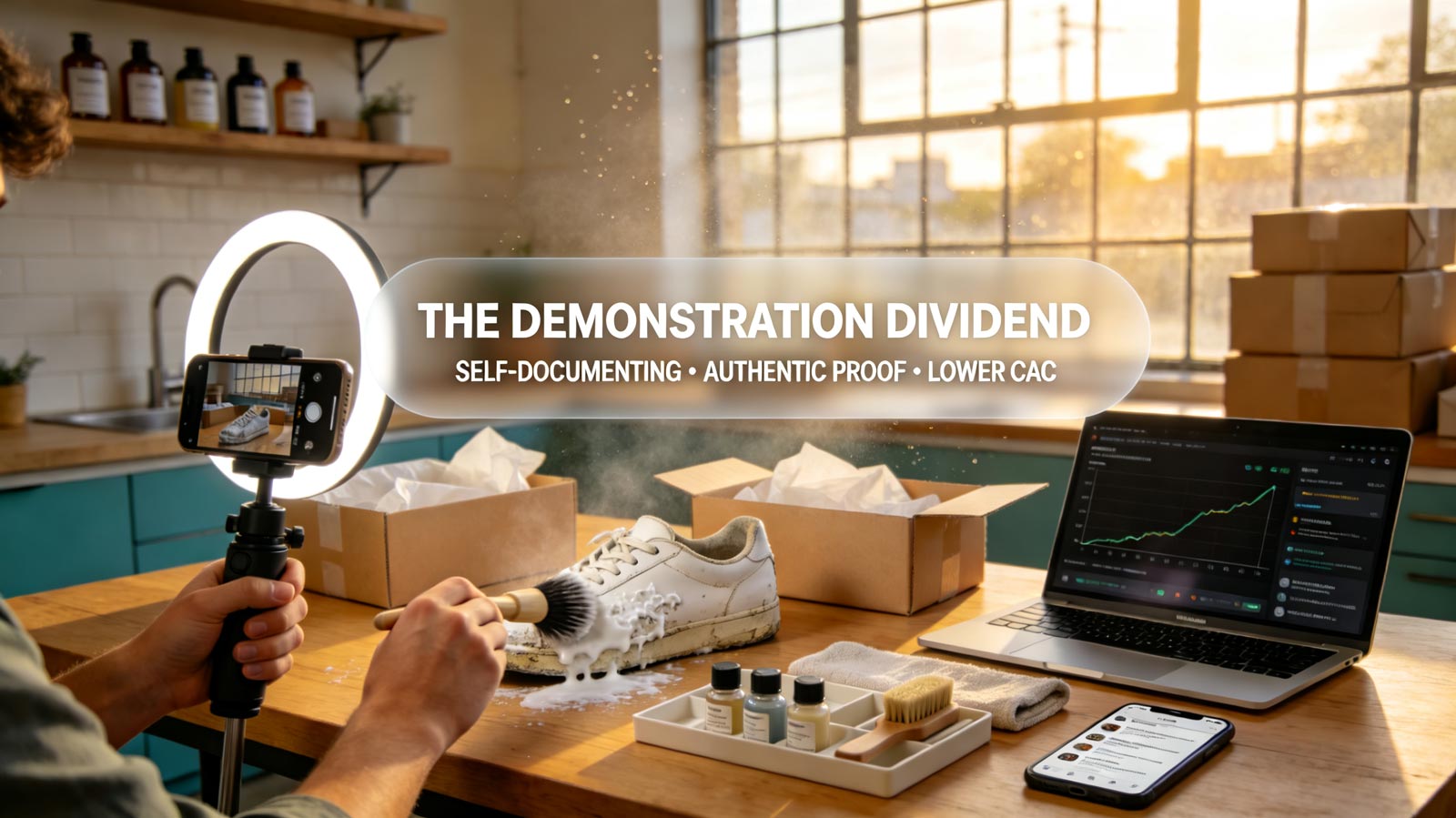
Niche restoration sets (sneaker cleaning, jewelry polishing, car interior detailing) deliver the strongest ruined-to-restored arc in short video. Margins typically run 35%–48%; compact form factors keep logistics simple.
- Validation signal: high video-review density and active restoration hashtags in comparable listings
- Ops note: never fake the "before" state—staged dirt triggers moderation and refund spikes; liquid or paste formulas need leak-proof, market-compliant packaging confirmed with your manufacturer
2. Process-Reveal Kitchen Tools — Strong on process satisfaction
Dumpling molds, spiral slicers, pastry presses—tools where the demo is the recipe. Every buyer generates a new variation, making content supply scale with sales. Margins around 30%–40%, with natural gifting overlap.
- Validation signal: cooking-process hashtags with stable multi-month view volume, not a single viral spike
- Ops note: rigid, angular gadgets suffer corner damage in cross-border transit; overseas-warehouse stocking with standardized inner packaging controls both damage rates and volumetric-weight surprises
3. Measurable-Result Self-Care Tools — Strong on single-frame measurability
Scalp massagers, exfoliation systems, manual therapy tools produce progress buyers track across weeks—content arcs that outlast one-off virality and support premium pricing at 38%–50% margins.
- Validation signal: multi-week "week 1 vs. week 4" content already circulating in the niche
- Ops note: frame claims around sensory experience and routine comfort; medical or therapeutic wording invites ad-platform policy action and regional compliance flags. Hygiene-sensitive SKUs need sealed, retail-ready packaging
Running the Flywheel Without Burning Budget
- Seed before scaling. Ship 20–30 units to micro-creators with a scene brief—problem state, process clip, result frame—and no script. Unbriefed authenticity consistently outperforms directed content.
- Rotate hooks, not products. One validated SKU supports five to eight distinct angles. Refresh weekly and pull any creative once click-through decays by roughly 30% from its peak.
- Harvest proof. Request post-purchase video reviews via fulfillment inserts, secure usage rights, and feed the strongest clips into retargeting.
- Review monthly. When authentic creatives sustain roughly 2× the efficiency of studio content, shift budget from production to creator seeding and replenishment depth.
Three guardrails protect the asset: run a 50-order durability trial before seeding (a beautiful demo that fails in two weeks generates refund videos, not growth); keep footage within authentic performance limits, because inflated expectations convert directly into return rates; and avoid recognizable third-party brands in restoration or accessory demos to prevent IP takedowns.
Core Takeaways
- Content supply, not media cost, is now the binding growth constraint; demonstrability is a screenable product attribute, as measurable as margin or return rate.
- Apply the Self-Documenting Score (commit only at 6/8) and confirm with pre-inventory evidence—hashtag volume and review-video density—before bulk stock commitments.
- Restoration kits, process-reveal kitchen tools, and measurable-result self-care lead on different score dimensions, share low seasonality, and suit late-2026 to 2027 planning.
- Protect the dividend with demo-durable quality, camera-ready packaging, overseas-warehouse delivery speed, and a monthly creative-efficiency review.